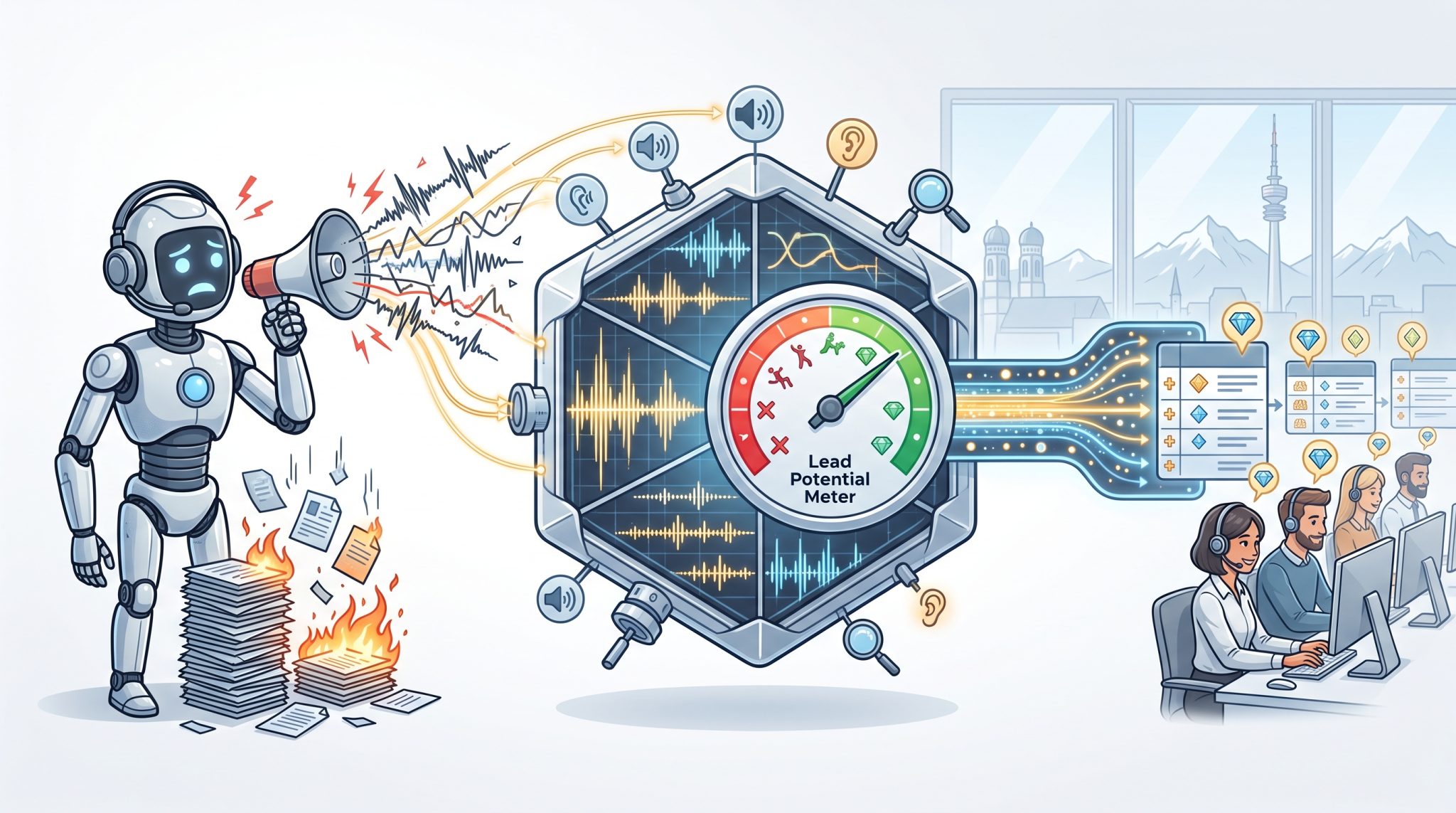
A Tier-1 European health insurance provider was burning through its outbound lead list because a proactive AI pilot experienced high drop-off rates during the initial greeting. I architected an „Acoustic UX“ tracking layer and a dynamic Lead Potential Meter that analyzed exactly when users disconnected, transforming opaque „failed calls“ into a highly qualified, prioritized pipeline for the human sales team.
1. Context & Challenge
- Baseline: A massive European health insurance and financial services enterprise was piloting a proactive outbound AI assistant to schedule advisory appointments with hard-to-reach leads.
- The Bottleneck: During the live 600-call pilot, the bot faced a steep challenge: users were hanging up within the first ten seconds. Traditional analytics systems simply labeled these as „Failed – Disconnected,“ offering zero actionable intelligence to the contact center.
- The Stakes: Treating every drop-off as a dead lead meant rapidly burning through valuable prospect lists and wasting marketing acquisition budget. The human sales team was growing frustrated, viewing the AI as a flawed conversion killer rather than a helpful operational assistant.
2. My Role & Strategic Approach
- Involvement: As the AI UX Lead and Innovation Strategist, I took ownership of the pilot’s conversational analytics and engineering to rescue the perceived ROI of the initiative.
- The Core Insight: A hang-up is not a failure; it is a high-signal behavioral data point. I realized that when a user hangs up tells us exactly why they hung up. If they disconnect at the phrase „Digital Assistant,“ they are bot-averse. If they disconnect at „schedule an appointment,“ they are likely just busy. We needed to stop discarding leads and start scoring their silence.

3. Solution Architecture & Execution
- Intervention 1: I engineered a micro-milestone tracking system deeply embedded within the natural language understanding (NLU) flow. By injecting timestamp nodes into the first 10 seconds of the AI’s greeting, I could track the exact phrase being spoken when the user broke the connection.
- Intervention 2: I coded a custom „Lead Potential Meter“ directly into the bot’s context logic. The system autonomously scored every dropped call based on the exact drop-off node combined with call duration, instantly distinguishing a hard topical rejection from a bad timing issue.
- Intervention 3: I mapped this scoring logic into an automated data handover pipeline. Instead of generating a binary success/fail report, the AI exported a rich behavioral matrix that routed high-potential „busy“ drop-offs directly into a human agent’s priority queue for a callback the very next day.

4. Quantifiable Impact & Transformation
- Pinpointed exact conversational friction points with granular precision, revealing that 12% dropped at the AI disclosure, 12% at the topic reveal, and 6% at the goal statement.
- Rescued previously lost leads by generating a prioritized list of verified, highly receptive contacts for human intervention, directly preventing top-of-funnel pipeline loss.
- Optimized human agent velocity by mapping exact availability windows—identifying verified phone numbers and precise timeframes when prospects were guaranteed to answer the phone.
- Qualitative Shift: The sales team’s perception of the AI fundamentally transformed. They stopped viewing the voicebot as a failed „closer“ and embraced it as a highly sophisticated „lead qualifier“ that enriched their CRM data even when it failed to secure a booking itself.
5. Key Takeaways
- Analyze the Silence: In voice AI, a user disconnecting is a high-signal action. Building granular node tracking allows you to decode human behavior and rescue lost conversions from the void.
- AI as a Filter, Not Just a Closer: Even a „failed“ AI interaction can generate immense business value if it is architected to filter, score, and prep the lead for a human expert.

Du muss angemeldet sein, um einen Kommentar zu veröffentlichen.