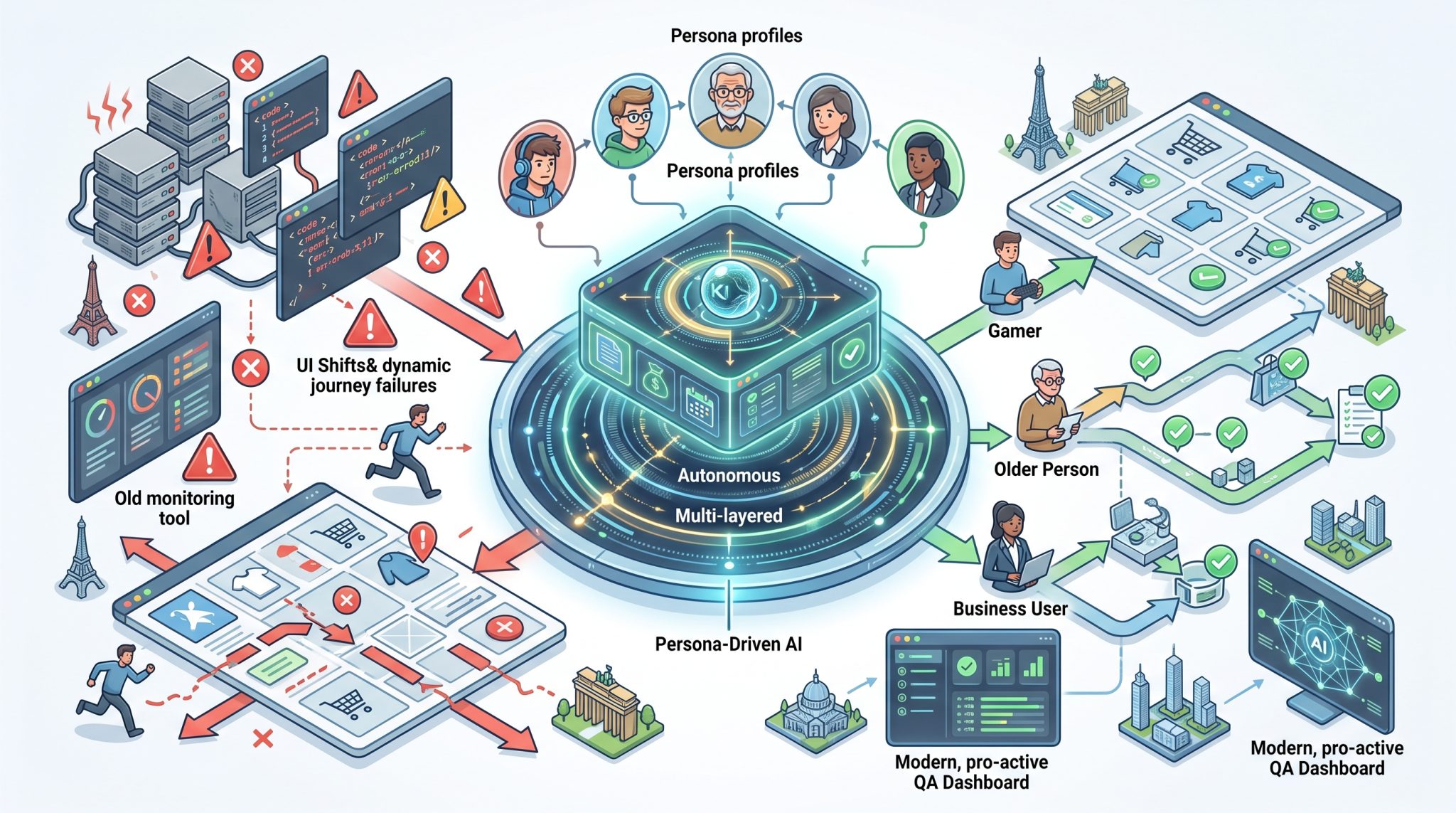
A massive European digital telecommunications provider struggled with undetected UI shifts and dynamic user journey failures that evaded standard technical monitoring. I architected an autonomous, multi-layered AI agent capable of simulating realistic persona-based workflows, shifting their quality assurance from reactive crash-logging to proactive, context-aware UX testing.
1. Context & Challenge
- Baseline: A high-traffic European telecommunications and digital retail platform constantly deploying new product bundles, tariffs, and landing pages to millions of daily users.
- The Bottleneck: Traditional monitoring tools and static automation scripts (like Selenium) only caught hard technical crashes. Complex UX friction, rendering shifts from Client-Side Rendering (CSR), and dynamic 404 errors deeply embedded in the user journey were slipping into production. Whenever a new marketing modal or cookie banner misfired, it blocked the funnel.
- The Stakes: Undetected UI bugs and broken conversion paths cost thousands of euros daily in lost sales. The manual QA overhead required to test every edge case across diverse customer personas was unsustainable and bottlenecked rapid deployments.
2. My Role & Strategic Approach
- Involvement: As the Innovation Strategist and AI UX Lead, I took ownership of redefining the digital quality assurance pipeline, moving the client away from rigid testing scripts toward adaptive AI exploration.
- The Core Insight: Bots check for code, but humans experience interfaces. To find real conversion blockers, I realized we didn’t need another technical scraper. We needed an autonomous AI agent capable of mimicking the contextual behavior, frustration thresholds, and navigation paths of specific human user personas.

3. Solution Architecture & Execution
- Intervention 1: I architected a custom, three-layered AI agent. Level one performed a baseline system and UI scan. Level two tracked dynamically generated 404 links. Level three was the core engine: a persona-based testing module.
- Intervention 2: I integrated lightweight LLMs to act as specific customer segments (e.g., a „heavy data user“ looking for upgrades). The agent autonomously navigated the live UI, identifying contextual friction points, overcoming disruptive modal pop-ups, and flagging visual shifts that broke the flow.
- Intervention 3: I built an automated diagnostic pipeline. Instead of just flagging a generic error, the agent autonomously compiled comprehensive JSON logs, captured contextual screenshots, and updated the site mapping with actionable UX suggestions, providing the development team with a ready-to-fix diagnostic package.

4. Quantifiable Impact & Transformation
- Shipped a functional, multi-layered Agentic QA prototype in under 3 weeks, bypassing sluggish legacy testing roadmaps.
- Autonomously identified and logged disruptive UI modals and contextual dead-ends that had previously bypassed 100% of the standard automated technical monitors.
- Replaced manual, repetitive visual regression checks with a continuous, low-cost LLM-driven loop, yielding a massive reduction in manual QA hours per deployment cycle.
- Qualitative Shift: Transformed the QA process from a technical checkpoint into a user-centric diagnostic tool. Developers no longer received generic „error codes“ but rather contextual, visual evidence of exactly where and why a specific user persona failed to convert.
5. Key Takeaways
- Experience Over Code: Quality assurance must evolve from checking code syntax to experiencing the interface. Agentic AI is uniquely positioned to test contextual user friction because it can visually „see“ and interpret the screen.
- Adaptive Over Rigid: Traditional test scripts break when a UI button moves five pixels to the left. An AI agent understands the intent („click the checkout button“) and adapts to layout changes, drastically reducing test maintenance overhead.

Du muss angemeldet sein, um einen Kommentar zu veröffentlichen.