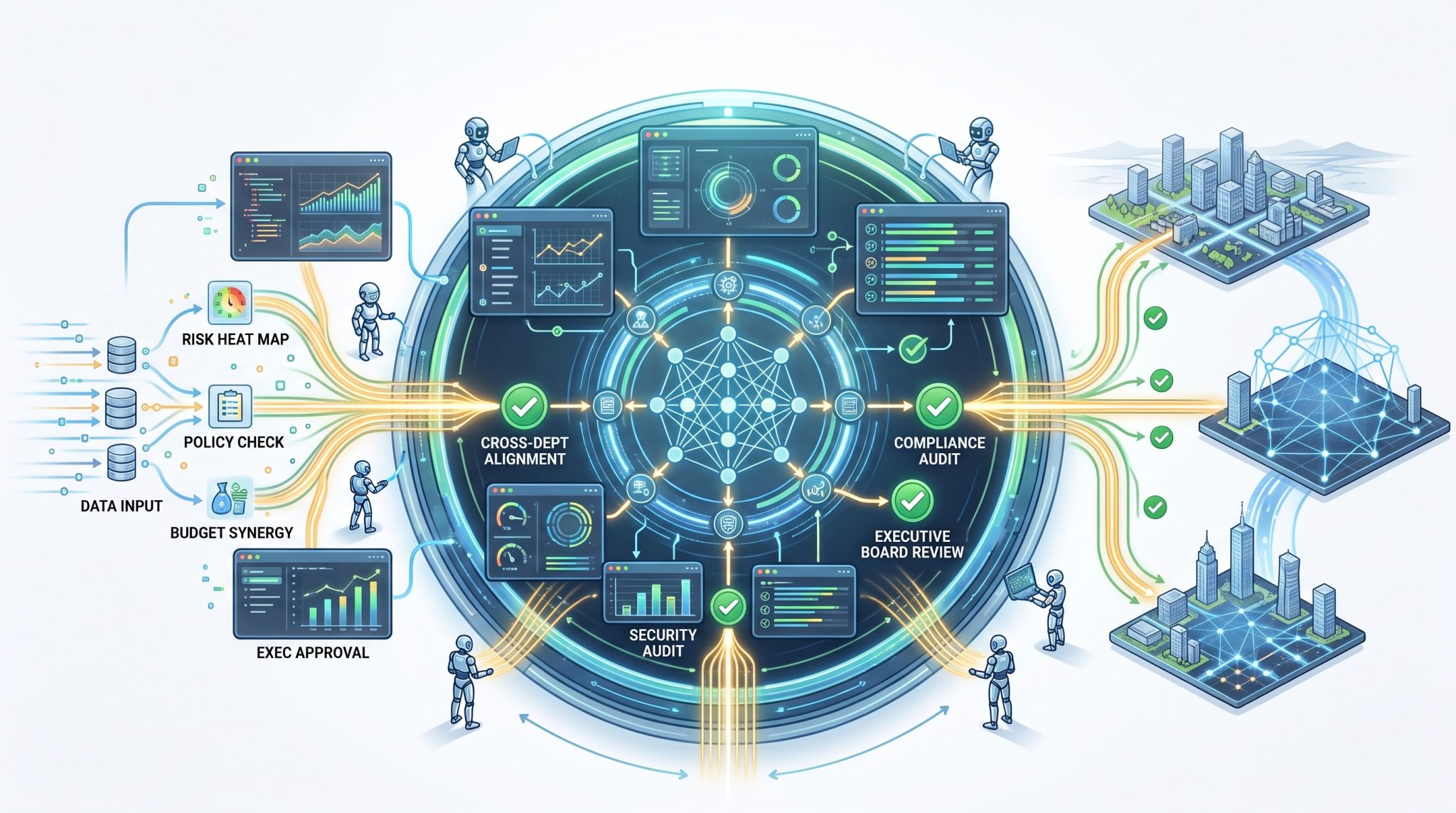
A Tier-1 European telecommunications provider was suffering from fragmented, uncoordinated AI initiatives spinning up across multiple departments, creating massive security risks and redundant costs. I architected a centralized, interactive AI Governance Hub that transformed the chaotic journey from raw idea to executive approval into a guided, frictionless, and fully compliant pipeline.
1. Context & Challenge
- Baseline: A massive telecommunications enterprise was experiencing rapid, decentralized adoption of Generative AI capabilities across its commercial, marketing, and operational divisions.
- The Bottleneck: The organization was trapped in a „wild west“ phase of AI adoption. Various departments were launching siloed pilots without standardized UX guidelines, IT architecture validation, or data privacy checks. There was no centralized intake process to evaluate cross-departmental synergies, leading to a bottleneck where steering committees were overwhelmed with disconnected, improperly vetted AI pitches.
- The Stakes: Millions of euros risked being wasted on overlapping third-party AI tools and redundant development efforts. More critically, the lack of centralized compliance checks exposed the enterprise to severe data privacy violations and internal political friction between overarching corporate strategy and agile departmental execution.
2. My Role & Strategic Approach
- Involvement: As the Innovation Strategist, my mandate was to bring immediate structure to these fragmented initiatives, consolidate the enterprise’s AI portfolio, and design a sustainable pathway for future AI scaling.
- The Core Insight: I realized that enforcing top-down, bureaucratic compliance usually stifles innovation and encourages „shadow IT.“ The strategic breakthrough was designing an interactive „Intake-to-Execution“ platform that made following the rules the path of least resistance. By offering employees an enablement tool that actively helped them build their business cases, we could bake compliance directly into the ideation process.
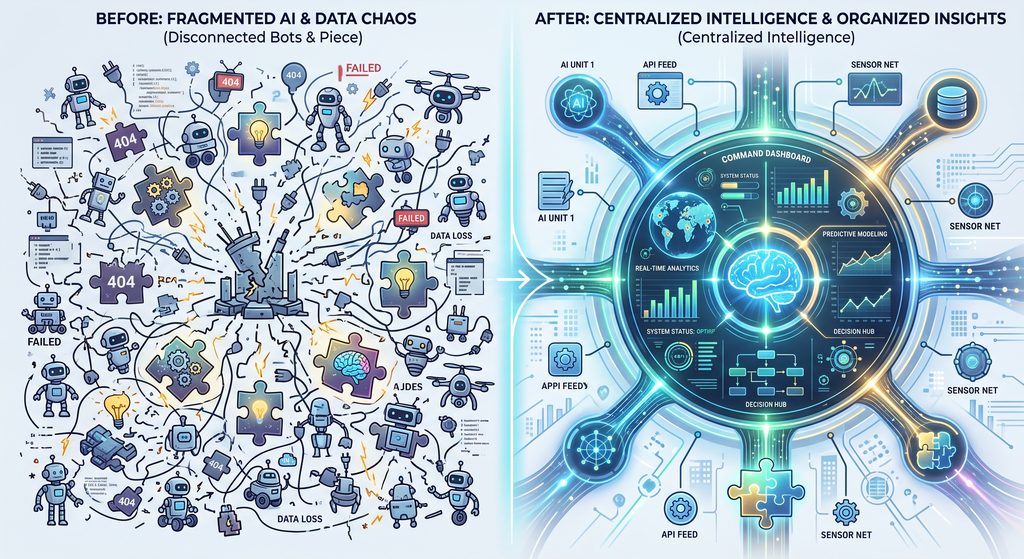
3. Solution Architecture & Execution
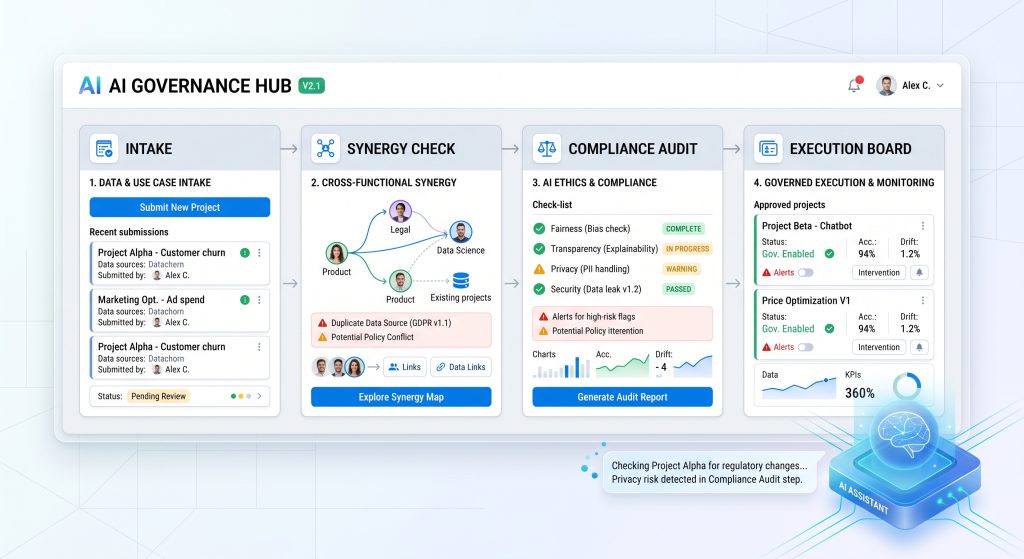
- Intervention 1: I designed and engineered a comprehensive, 12-stage interactive governance portal. This platform guided users seamlessly from their initial idea (assisted by an embedded AI chatbot for brainstorming) through mandatory synergy checks and a centralized corporate tool registry to prevent redundant vendor onboarding.
- Intervention 2: I integrated automated „Compliance Paper“ tests directly into the user flow. Instead of requiring separate, lengthy legal and IT reviews, the hub dynamically structured data privacy, IT architecture, and business case requirements, culminating in a standardized, exportable pitch deck format ready for executive steering committee approval.
- Intervention 3: I ensured absolute frictionless adoption by building the high-fidelity prototype strictly using the enterprise’s proprietary design system tokens. The bilingual portal featured a floating AI assistant and synced directly with downstream agile execution boards, bridging the gap between high-level strategy and technical delivery.
4. Quantifiable Impact & Transformation
- Delivered a comprehensive 12-stage governance prototype that mapped the entire AI lifecycle, consolidating fragmented departmental efforts into a single, unified architectural vision.
- Accelerated the project intake cycle by transforming manual IT, legal, and privacy alignment into a guided, self-service digital compliance workflow.
- Shipped a fully functional, bilingual high-fidelity portal that successfully secured immediate buy-in from core IT stakeholders and established a clear path for corporate change management.
- Qualitative Shift: The platform fundamentally shifted the corporate culture from chaotic experimentation to structured, scalable innovation. Teams were empowered with a transparent, standardized pipeline to pitch, validate, and execute their AI ideas safely, turning corporate governance from a gatekeeper into an enabler.
5. Key Takeaways
- Design for Compliance: If you want employees to follow strict AI governance and security rules, you must design a workflow where compliance is built directly into a supportive, user-centric journey rather than an administrative hurdle.
- Centralize the ‚Wild West‘: A unified corporate AI strategy requires a unified digital home. Centralizing ideation, tool registries, and execution prevents operational silos and fosters massive cross-departmental synergies.

Du muss angemeldet sein, um einen Kommentar zu veröffentlichen.