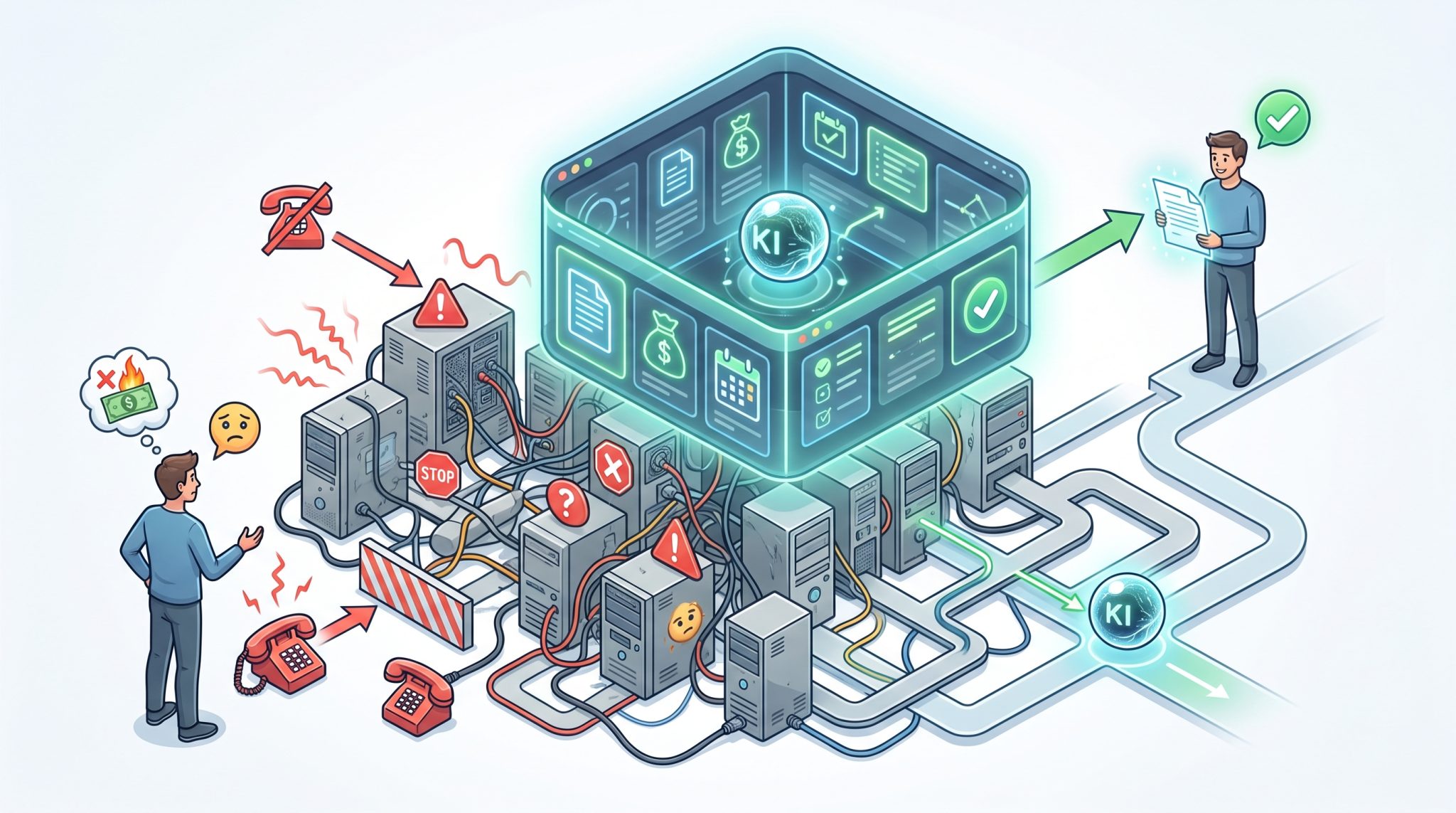
A major European health insurance provider struggled with a complex mobile app that drove frustrated users straight to expensive support hotlines. Instead of initiating a multi-year backend overhaul, I architected an „Agentic Wrapper“—a proactive AI layer that sits on top of the existing app, autonomously navigating legacy interfaces on behalf of the user to instantly resolve requests.
1. Context & Challenge
- Baseline: A leading statutory health insurance provider serving millions of members relies on a comprehensive, highly secure mobile application for digital self-service, ranging from document retrieval to bonus program management.
- The Bottleneck: As features expanded, the app’s architecture grew overly complex, causing severe user navigation issues. Users frequently failed to find specific services or forms, leading to high drop-off rates and overwhelming the human call centers. However, modifying the deeply entrenched, highly regulated backend systems to natively support conversational AI required an unsustainable multi-year IT roadmap.
- The Stakes: Plummeting digital adoption rates and spiraling operational costs in the contact center. If the digital experience wasn’t simplified immediately, the provider risked alienating its user base and failing its critical operational efficiency targets.
2. My Role & Strategic Approach
- Involvement: As the Innovation Strategist and AI UX Lead, I was tasked with bridging the gap between executive efficiency goals and the rigid realities of legacy IT infrastructure.
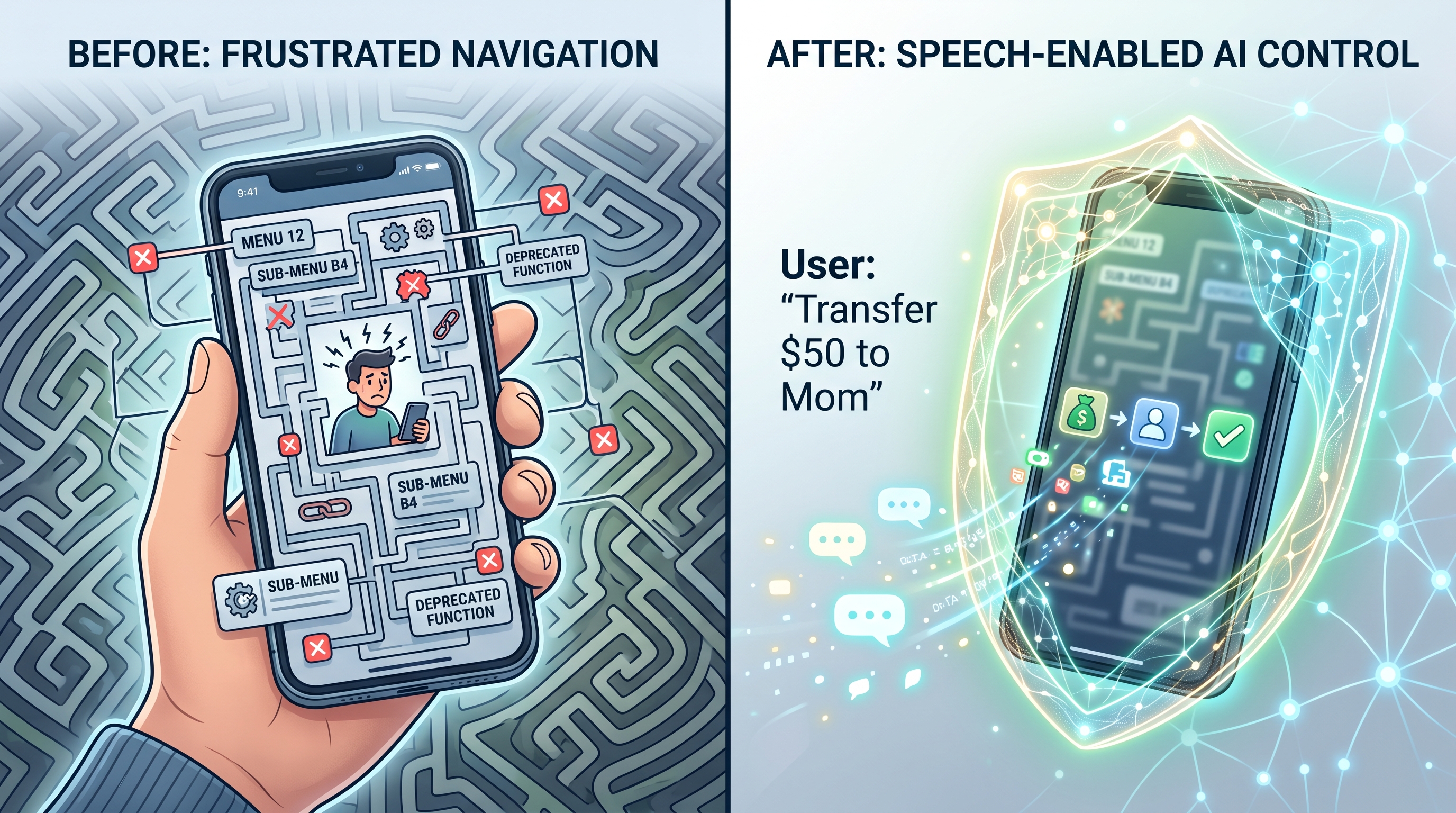
- The Core Insight: I realized we didn’t need to rebuild the backend or redesign the entire app interface. The breakthrough was designing an „Agentic Wrapper“—a conversational AI layer that operates the existing app for the user. Instead of exposing the database to an LLM, the AI handles the complex navigation, interacting directly with the app’s frontend elements to shield the user from the underlying UX friction.
3. Solution Architecture & Execution
- Intervention 1: I initiated targeted dual-track design sprints to map out both the external customer friction points (app drop-offs) and internal employee bottlenecks. This holistic view identified exactly where an AI layer could intercept users before they abandoned the digital channel.
- Intervention 2: I conceptualized a unified AI assistant that integrates strictly at the presentation layer. Instead of waiting for deep API backend integrations, the agent leverages existing frontend automations to execute tasks—like retrieving tax documents or checking claim statuses—directly within the app environment.
- Intervention 3: To ensure long-term scalability, I mapped out an architecture where all disjointed internal automations and the new external app capabilities are consolidated under a single Model Context Protocol (MCP). This strategy created a unified digital brain capable of routing intents without ever touching the legacy core.

4. Quantifiable Impact & Transformation
- Shipped a comprehensive, C-level approved architectural blueprint and high-fidelity mockups, reducing a projected 18-month IT discovery phase into a single agile design sprint.
- Bypassed major regulatory and legacy backend dependencies, unlocking immediate, compliant AI innovation by restricting the agent’s actions purely to the front-end user space.
- Established a unified structural roadmap that merged disjointed internal employee automations with external customer-facing features under one scalable MCP framework.
- Qualitative Shift: Fundamentally transformed executive perspective. Leadership shifted from viewing AI as a risky, heavy backend overhaul to embracing it as an agile, low-friction UX overlay, drastically accelerating the organization’s overall AI readiness.
5. Key Takeaways
- Wrap, Don’t Rebuild: In heavily regulated or legacy-bound enterprises, do not wait for the backend to modernize. You can achieve immediate ROI by deploying agentic AI to navigate and operate the existing front-end interface on behalf of the user.
- Holistic Journey Alignment: Unifying internal employee automations and external customer interactions under a single standard protocol prevents organizational silos and creates a cohesive, scalable AI ecosystem.

Du muss angemeldet sein, um einen Kommentar zu veröffentlichen.